
Our Labyrinth
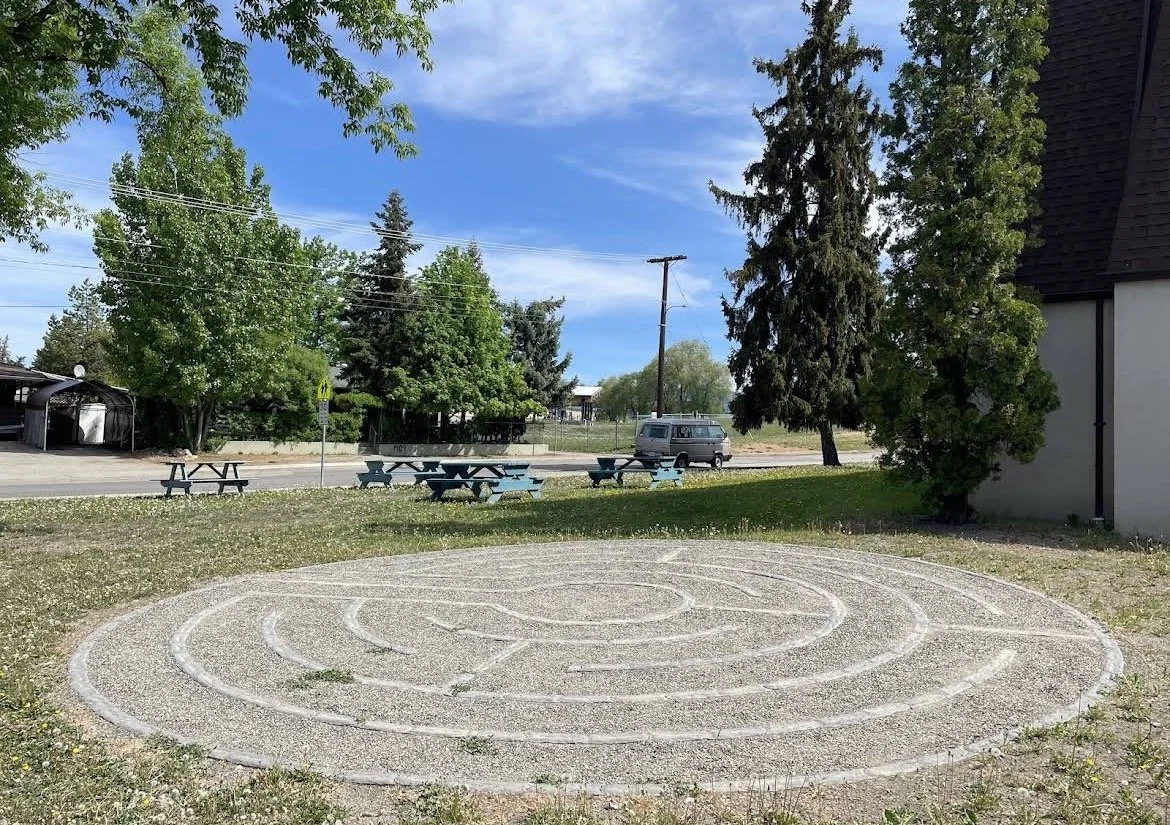
What is a labyrinth?
A labyrinth is a symbol found in many cultures from ancient to modern times. If you visit Chartres in Northern France, you will find it on the stone floor of the ancient Cathedral. The feet of the faithful have walked its path in prayerful meditation since the 13th century. It represents a pilgrimage of the soul which follows a long, winding yet purposeful path that finally comes to a centre, then winds its way out again. There are no obstacles, no puzzles; it is not a maze. There is one unbroken path to follow.
Sometimes the words ‘labyrinth’ and ‘maze’ are confused. While both refer to circling patterns, the two are totally different. A maze is a puzzle and thus designed to confuse; walkers must use their reason and cunning to escape. A labyrinth is a single path that leads the walker to the centre and back out. In an open, receptive frame of mind, the walker simply follows the path and experiences a refreshing form of meditation.
Why walk the labyrinth?
The experience of walking the labyrinth will be different for each person and different each time the path is walked. Many have found it to be a tool to guide healing (of the mind, spirit and body), to awaken the Spirit within them, to spark creativity. Walking the labyrinth quiets the busy mind and enables a person to see their life in the context of a path or journey. It often gives solace and peace, and encourages action empowered by the Spirit.
Metaphorically speaking, we are all spiritual seekers, on a path together, looking for meaning and purpose for our lives. The labyrinth provides a symbol that is also quite literal as it presents us with a real path upon which to really walk together.
The labyrinth is a spiritual tool that is used as a centering activity. It is meant to be walked as a form of meditation, and in the walking, the spirit finds healing and wholeness.
There is no absolutely right way to walk the labyrinth. Choose your pace: slow, moderate or fast. Most walk alone, but you may choose to walk with another. If you meet someone on the path, pass quietly or move aside and then continue. You may not want to make eye contact, or (if you know them) you may wish to touch in passing. The walking meditation may be used in several ways according to your needs and wishes.
Here are a few suggestions to help you begin:
Breathe deeply, centre yourself and enter the path. Begin to move forward and find the pace your body wants. If you have a particular issue you are praying about, hold that in your heart. You may silently repeat a phrase from a hymn or a prayer. If you wish, you can pause now and then to record your thoughts in writing. As you walk to the centre, relax and release the thoughts and concerns of life, allowing your mind to become quiet. When you reach the centre, stay there as long as you like. Listen for the voice of the Spirit within you. As you walk out of the centre, retracing the path that brought you in, allow a new perspective and a new energy to fill you as you continue on your spiritual path in life.